Showing posts with label museum. Show all posts

Tuesday, October 22, 2013

Greece is the word

Ruined Erechtheion temple, Acropolis.
 It might have been nice to leave on Thursday night, but we couldn’t leave any earlier than Monday because of the way Eid Al Adha was declared this year. Late. With less than a week to go, we learned from rumours published in the official national newspapers that the Public Sector would get a full nine days off. The government decreed that the Private Sector could come in to work on both Sunday 14th and Thursday 17th October and like it.

Beloved Wife had booked Monday to Saturday, anticipating that these days at least would not be work days for her, and we set off for Athens at 10am on Monday morning. I’ve never been to Greece.

In keeping with tradition, custom, and practice, the flight was 20 minutes late out of Dubai. Oh, and left from Terminal 1. It’s a long walk from the T3 taxi dropoff to the aircraft.

Breakfast in McGettigan’s (the airport Irish pub formerly known as the Irish Village) consisted of an ‘Irish Breakfast’ plus a pint of Guinness for me, and Eggs Benedict and cider for Beloved Wife. An Irish friend of mine assures me that it’s soda bread that turns a Full English into a Full Irish. Breakfast was yummy, albeit not even slightly Irish. Apart from the Guinness, obviously. And with the sun barely over the yard-arm. I’m shocked at myself.

I think I’ve found a way to get peace aboard aircraft: wear earplugs under the headphones. The plugs cut out virtually all of the jet roar and infants’ screams, but it’s still possible to hear the movie soundtrack. One disadvantage is the way that earplugs tend to allow internal sounds to seem exaggerated. Eating cream crackers makes one helluva din.

There were about three of us in the EU Citizens queue at Athens airport, so poor, foreign Beloved Wife had to weave back and forth while her Goat wandered around and picked up some discount cards that apparently work at museums, restaurants, shops, and spas. They don't. "Athens Spotlighted' cards were absolutely useless wherever we presented them.

The metro took us straight into central Athens at a cost of €14 for two (travelling together (compare with €8 each for singles)), and it took around 45 minutes to get to our hotel. We decided not to rush and immediately buy week-long transport passes at €20 a pop, airport trips excluded (when single journeys were €1.20), partly because the map in our Lonely Planet guidebook seemed rather to suggest that all the stuff we were likely to want to see was within walking distance of our hotel.

The Hotel Fresh was excellent. It's Four-Star and therefore a bit pricy, and is in a grotty area of town. However, it's clean, the rooftop bar and restaurant are very good, breakfast is marvellous and extremely comprehensive, and there's free wireless internet all over the building. It's also a short walk to the tourist area and ancient sites, and to the Metro.

Having checked in, chilled out, and fought with my computer, we retired to the rooftop bar for beer o’clock and a sunset look over the Athenian rooftops to the mountains beyond and the Acropolis, which is surprisingly close.

Part of the view from the hotel's rooftop bar.
The evening walk from the hotel down to the tourist area took us through a seedy-looking neighbourhood. It looked like the hardware souq. Most of the tourist shops were selling the same selection of alabaster gods and heroes. One shopkeeper did agree with me that it was a bit odd selling images of ancient Sparta in Athens: the Spartans and the Athenians basically hated each other’s guts. Oh, and of the fauns and satyrs for sale, most were – to say the least - anatomically ambitious, which is more than you can say about Greek gods and heroes.

This Is Athens. Not Sparta.
The only thing, aside from food, that we bought this evening was a hat. Muggins forgot his Very Pterry Hat, and on Tuesday would be appearing in public on the Acropolis as a bekilted Goat From Del Monte.

Tuesday: "Acropolis" is more-or-less Greek for "Uptown."

Nobody knows if Athens is named after Athena, or the goddess Athena is named after Athens. But what is certain is that the ancient Greeks adopted Athena as their own goddess of wisdom, chastity and moderation and built a huge temple on top of a hill in the middle of the city.

And to this temple we slogged. It’s uphill all the way. The basic fee to see the Parthenon on the Acropolis is €12, and this includes various other sights and sites such as the Theatre of Dionysos, and Agora. If you buy individual admissions to the smaller sites, you’ll still get hit up for €12 for the Parthenon, so pay for the lot up front. Thank you Lonely Planet.

Erectheion by night.
Front row of caryatids at the Erectheion. These are copies.
Five of the originals are in the Acropolis Museum in Athens;
the sixth is in the British Museum in London.
The Parthenon. Nearest to the camera is the southeast corner.
I confess to a little gentle Photoshoppery. I’ve trued up the verticals and removed the cranes that make the Acropolis look like a building site.

Several people ‘liked’ my kilt, in a Facebook sort of way. Mostly Aussies and Canucks, plus a couple of Greeks. One mature American lady confessed to “Really liking MIKs.” As a Utiliclan member, I’m an unpaid ambassador for Utilikilts, so I dished out business cards. Brace yourselves, Utilikilts Seattle!


Kilted photographer at the Theatre of Dionysos.
Kilted photographer was allowed to take pictures without flash,
except in the Acropolis Museum where all photography was forbidden.
It was a minor disappointment not to be able to walk around inside the ruined temples, but they were building sites, so I basically understand. What was less understandable was the outright ban on photography in the Acropolis Museum (unless, apparently, it was undertaken surreptitiously with a telephone.) Muggins with his DSLR stood no chance.


Acropolis Museum main entrance.
Below is part of ancient Athens.
The museum is very interesting. The top floor is an exact layout of the top of the Parthenon, and the friezes and marbles, or copies, are displayed exactly as they would have appeared on the monument if it hadn’t been vandalised by arsonists in the fourth century AD, the early Christian church, the Turks who turned it into a mosque, the genius who stored gunpowder inside and had an explosion, more Turks who tore bits down to make a signal tower, and Lord Elgin.

The museum very much takes the attitude that the twirly-moustachioed villain Lord Elgin took advantage, and stole the Marbles for his own purposes. They’re in the British Museum, along with one of the columns and a caryatid from the Erechtheion, an adjacent temple. In one version of the story promulgated by the museum, the Turks were using marble from the Parthenon to build their own new tower and Elgin realised that he could obtain permission to take the Marbles before they became part of a new structure. In another version, Elgin’s cronies hacked the Marbles off and stole them away without Greek consent.

But I feel that, as most of the site was being pillaged by all and sundry in 1801, it’s far better that the Marbles ended up in a foreign museum than as a Turkish tower or hardcore beneath a new road. How many different bas-reliefs of Centaurs fighting Lapiths does one museum need? Should the British Museum give the reliefs back to Greece? I really don’t know.

The friezes are on display on the top floor.
Back to the museum. The lower floors are orientated to fit the adjacent streets, so the top floor is at a peculiar angle. Parts of the ground floor are glass, and it’s possible to look beneath the museum at the walls and wells of ancient Athens, plus archaeologists working on them under glass but in air-conditioned comfort. The columns holding up this magnificent new building carefully avoid the archaeology, you will be relieved to learn.


The Odeon of Herodes Atticus used to have a roof.
Presently, Beloved Wife declared Cake O’Clock, which was followed by more walking, this time around the southern side of the Acropolis. Agora (Roman; temple; ruins) closed at 3pm, so we’d have to visit that tomorrow. I attempted to order my coffee and salad by reading the Greek and mispronouncing it at the waiter. Success at my third attempt: I must have the world’s worst Greek accent.

I gave to a busker who was standing in front of Roman Agora and playing a tenor recorder. One of my musical instruments of choice, he was clearly a better player than I, but he was helped by a microphone, amplifier, and a backing track.
A busker, recordering in front of Roman Agora.
We discovered the flea market. Definitely the place to go for crappy, broken furniture, dodgy fake Reeboks, and military apparel. The place was overrun by army surplus stores. Having bought precisely nothing, we headed back to the hotel for a short siesta prior to heading out for food.

Wednesday: Oh noes! Rain.

We very quickly had our dilemma – south to Agora or north to the National Archaeological Museum – solved. The museum represented a day of indoor culture.


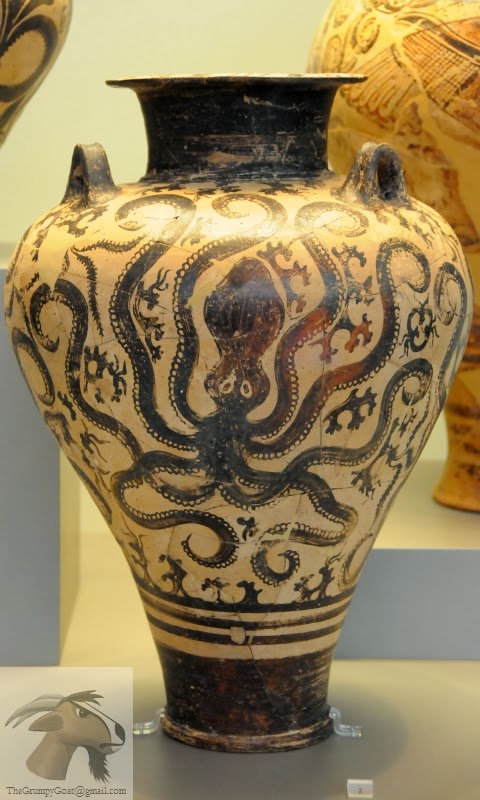
The octopus motif appeared again and again.

Mosaic Medusa.
Some mythological deal being made over at Pan's house.
First century BC bronze racehorse.
Here we have Aphrodite, accompanied by Eros, beating off Pan.
You can see she's having at the satyr with her shoe.

Why, what did you think I meant?
And what culture! From the gold, bronze, and pottery of ancient Mycenae, through sculptures dating from around 800BC to 100AD; glass from the Archaic period up to the 1300AD; terracotta; and bronze. It’s all somewhat overwhelming to think how incredibly old some of this stuff is. I found a 5000 year old piggy bank. The plaque said it was a vase, but it looked exactly like a piggy bank and not much like an actual pig.

Zoomorphic vase or piggy bank?
Beloved Wife declared Cake O’Clock, and we retired to the basement level for cake and coffee. The rain was still hurling down in the middle of the quadrangle, and we had the choice of either fresh air and tobacco, or stale indoor air and coffee. We chose the latter, mostly because all the tables in the covered arcade were occupied.

Zeus, King of the Gods.
It looks like the thunderbolt he's throwing has been lost in the mists of time.
Funerary monument to a fallen Greek warrior.
The museum shop missed a trick, though. There are a lot of examples of Mycenaean jewellery on display and, according to Beloved Wife, reproductions of these should have been available for sale.

There was a special exhibition of the Antikythera Shipwreck. The vessel sank in the first century BC and took a wealth of bronze, glass, marble, and The Antikythera Mechanism to the sea bed off the west end of Crete. Sponge divers discovered it in 1900, and Jacques Cousteau had another go in 1976. The museum made a big thing of The Mechanism, with a 3D film and displays showing how, over 2000 years ago, a mechanical device existed that could do celestial calculations. As I understand it (from the Greek soundtrack), you wound the handle to set the date and time, and pointers showed sunrise, sunset, moon phase, that sort of stuff. It’s the earliest example so far found of a portable astronomical calendar calculator, and predates similar machinery by an incredible millennium and a half.

The museum staff threw everyone out at about 1530, but by then the rain had at last stopped. We wove our way back to the hotel pausing to obtain beer, Coke, and crisps in a mini-mart. The plan was to take a break, and then to go out again for a late afternoon to evening session of sightseeing and restaurant.

We ended up at a streetside restaurant in the Plaka area, right on the northern slope of the Acropolis. There has been a town here for nearly 3000 years. The restaurant was very traditional, right down to the live bouzouki players and ritual breaking of crockery on the flagstones. I had lamb kleftiko for the first time since a few years ago in Cyprus: lamb, cooked slowly in a clay pot for several hours until it’s melt-in-the-mouth tender.

Also much in evidence were souvenir statuettes of gods and heroes. Beloved Wife has instructed that no such tchotchkes shall adorn the Crumbling Villa.

Thursday: Markets and Old Town

“Partly cloudy. 20°C” said the weather website. With blue skies overhead, we set out without an umbrella.

Ancient Agora and the Temple of Hephaestus were on the menu, along with the local food market. On our way around the market, some random Greek dude insisted that he have his picture taken with the bekilted Muggins. Shortly thereafter, he chased us down with a note containing (presumably) his name and address. He’d managed to work out that without this information, there would be no way we could let him have the picture. He even attempted to pay us for it. Unfortunately I managed to lose the scrap of paper, so if you know this guy, please get him to contact me.

Do you know this man?
The meat market. There's absolutely no doubt what this guy is selling.
Spices for sale. Beloved Wife bought some "Award-winning" olive oil,
but we have no idea what it's like.
Presently, we entered Ancient Agora using part of our ‘Acropolis and Everything’ tickets and, in accordance with the guide book, headed for a reconstructed arcade to get orientation about the site. The Stoa of Attalos has a museum on the ground floor and lots of statues and models on the upper floor that overlooks the site of ancient Athens.

Waiting for the rain to stop.
The big selling point is the Temple of Hephaestus, the best-preserved ancient temple in the world. It protrudes from multiple shades of greenery and really sells the place as Classical. At this point the heavens opened so, like everyone else, we hung around the ground-floor museum and then sat and waited for the rain to stop. By the time we got to the Temple of Hephaestus, the sky was blue and the damp ground was starting to steam in the sunlight.

The Temple of Hephaestus is surrounded by greenery.

South west corner of the Temple.
Many photographs later, at 1430 we were abruptly thrown out. The staff clearly want to go home spot on 1500.
Ancient Agora and the Acropolis, as seen from the Temple of Hephaestus.
Beloved Wife advised that the Museum of Cycladic Art was recommended by both the guide book and her friends. It was a tidy step away – at least a mile – but by curious happenstance was advertised as open until 2000 on Thursdays. So off we ambled, through the tourist shops and then the National Gardens (a park), pausing only once for coffee and cake.

It’s a small museum, but there are four floors of it. Paying our admission, we were advised to go to the top floor and work our way down. At the top were exhibits about Life in Ancient Greece, with artifacts, illustrations, and even a video of Scenes From Everyday Life. (Birth, betrothal, marriage, going off to war, funeral rites).

The Cup Bearer. Carved from marble about 5000 years ago.
The third floor contains a display of ancient art and culture from Cyprus, with items dating from 4000BC to 1800AD; mostly the very old stuff, and a lot of it in amazingly good condition. On the second floor are displays of ancient Greek art, with a lot of pottery and bronze, plus some glass and a number of interactive displays.

The first floor houses Cycladic art. Dating from 3000BC or thereabouts, this is the stuff that developed in the Neolithic and Bronze Ages in the Greek islands. There are many marble figurines in a distinctive style that could have been 20th century modern art. Picasso is one of the artists who nicked the style. The Cycladic people had little in the way of arable land, and scratched a living with a little agriculture and animal husbandry. But they had the sea, and became big-time maritime explorers and traders, and they also had masses of marble.   

This museum had not missed the same trick as the Archaeology Museum, offering for sale reproductions of the bling in the glass cases and reproductions of the marble figurines.

It became sunset and time to find food, so we staggered back through the shopping centre until we located a quiet restaurant in Plaka. I am pleased to note that I have failed to notice any McDonald’s outlets. In fact, the only big-name restaurant I’ve spotted so far is a TGI Friday’s, and that’s out among the foreign embassies and not in the middle of town.

Friday: Funicular fun

Today we went up the funicular railway to the Chapel of Agios Georgios. This chapel and attendant café and bar is right at the top of a hill a mile or so north west of the Acropolis. Owing to yesterday’s rain, the atmosphere was pretty clear, and I hoped to get some reasonable views and photos looking down on to ancient Agora. I wasn’t disappointed.

The green patch represents most of Ancient Athens.
Beloved Wife decreed that we’d take the metro two stops to the foot of the hill. We alighted at Evangelismos and headed up a seemingly never-ending flight of steps. I’m really glad I don’t have a job delivering grand pianos to the apartments served by these steps. Just as well we’d not walked from the hotel too. More than halfway up is the lower station for the funicular. It cost €7 return each. We were planning to get the train up and then walk down, but single tickets were not available. They are from the ticket machine at the top, which is a bit weird.

St George’s is a tiny traditional Byzantine chapel. The whitewashed exterior is inevitably covered with spray-painted graffiti, as is every other vertical surface in Athens. The hilltop is also covered with masts and antennae, so it’s quite a fiddle to get photos whilst avoiding these and their guy wires.

Coke and cake followed, as did beer. It was, perhaps surprisingly, not ludicrously priced bearing in mind the location. We speculated as to the lack of rooftop swimming pools and shortage of solar panels on the apartments stretching off to the edge of the Attic Basin.

It seemed a very long walk down from the funicular to the main street. Beloved Wife wished to visit the Byzantine and Christian Museum. This is magnificently laid out, and takes the visitor from the fourth century AD up to the nineteenth. Frescoes rescued from old churches that were flooded by reservoir schemes, stone bas-reliefs, icons. That sort of thing. It did occur to me that a huge Last Judgment could have been used by the artist to take all sorts of cheap shots at unpopular public figures by portraying their likenesses burning in the fiery pits of hell.

Elijah ascends to Heaven aboard a fiery chariot.
Fourteenth-century centaur, from an equally old church.
I was pretty iconed out by the time beer o’clock occurred, and then Beloved Wife mentioned that the Changing of the Guard was due to happen on the hour just down the road. We made it in good time to see the actually rather difficult high-stepping drill by the Greek soldiers in their ceremonial tunics, hose, and hobnailed shoes with pompoms. The two guys who started their one-hour stint at 1700 stand to attention for half an hour, then do ten minutes of pacing up and down, then stand for a further twenty minutes before being relieved. They’re back on duty at 2300. There’s a third Superintendent, whose job appears to be to talk to onlookers, prevent them from molesting the guards or taking the piss, and to ensure that the guards’ uniforms are exactly right.

Changing of the Guard. They do this on the hour, every hour.
The new guard makes the most of his time in the shade.
The first train to the airport on Saturday leaves at an unholy 0536. The hotel has, at least, offered a packed breakfast because we’re leaving before the breakfast we’ve paid for starts being served. And we’re doing our packing this evening, prior to our Riotous Night Out with one of Beloved Wife’s old friends and former colleagues from Dubai, now living in Athens.

Saturday: Back to reality

I do not function well on three hours’ sleep a night, and it was pretty much Dawn of the Living Dead by the time we rolled into Athens airport. I do not know how Emirates gets their aircraft back to Dubai from Athens, but we were obliged to fly Aegean to Milan in order to catch an Emirates flight. The self-check-in was a recalcitrant machine that showed us our flight details and then refused to issue boarding passes for the Emirates flight. And as we were carrying liquids, we had to check a bag, so we needed to deal with a person anyway.

I think we encountered the only Lawful Neutral person in Greece. It turns out that, in order to prevent leaking liquid food from ruining everyone’s luggage, Aegean has an inane rule that requires liquids to be packed in a wooden box. That a tin of olive oil – not a fragile glass bottle – was wrapped in plastic, then padded with underwear, then inside a suitcase was not good enough. No wooden box: no olive oil, and Beloved Wife found a Greek couple to give it away to.

Had we been desperate for some Greek olive oil, it would have been possible to buy it in the airport shop and transport it as carry-on. I hate the capricious ill-logic of airline security rules.

Aegean left late, so much so that someone met us at Milan and led us very swiftly across the entire, huge airport to where our Emirates flight was waiting. I asked, and was assured that our checked bag was on board, which it wasn’t, as we learned in Dubai six hours later. One of our aisle seats was also as far from an aisle as it’s possible to get on an Airbus A340; a lie that we discovered about five minutes after being spun this whopper.

When the bag was finally delivered some 24 hours later, it had been ripped open by persons unknown. Presumably by either cack-handed baggage handlers or airport security. Nothing was missing, and I went to Emirates the following day bag in hand, and eventually received financial compensation.

All in all, then, a fun break in Athens that was ruined at the end by airline security and mishandled luggage.

]}:-{>

Monday, September 02, 2013

Norse saga. Part IV – Norway Horsey

Wednesday 14 August

Twilight moon through some rigging.
We had an early departure from our subterranean Stockholm hotel, whose corridors looked exactly like those on the ferry. We didn’t have time for breakfast, but as that wasn’t included in the room rate it wasn’t a loss. The train to Oslo was not a sleek bullet train, but it seemed to travel fast enough through some very pretty fields, forests, and lakeland scenery.

Unfortunately, some yoof sitting exactly opposite us could have been the star of all Swedish translations of Tom Stoppard’s Talking Heads plays. This motormouth didn’t let up for six hours. If it wasn’t his mates (who couldn’t get a word in edgeways) it was his telephone victims. Even the next carriage, full of screaming brats, was inaudible: drowned out by Monologue Man.

The hotel turned out to be rather further from the railway station than originally planned, and then owing to map-reading challenges, wasn’t actually so far after all. We checked in, dropped our bags, changed, and then headed out for an afternoon snack and to be amused by the buskers, who included a double-bass player, and someone playing Bach’s Toccata in D-Minor on a piano accordion. The Living Statues don’t seem to get the idea at all, especially the ‘statue’ bit.

Oslo Fortress is free to get in, which was just as well because the various exhibitions where admission is payable were shut this late in the afternoon. The setting sun offered excellent light for interesting photographs.

Main entrance to Oslo fortress. There's a bridge over a dry moat and a wooden drawbridge.
Looks like someone's only blown the bloody doors off.
Inside Oslo fortress.
Oslo fortress: sea view.
And down on the quayside, the Mazda MX-5 Owners Club was having an informal meeting, so we chatted to the owners. Beloved Wife thinks she knows what her next car might be.

The light blue Miata/MX5 looks like it does the occasional track day. The dark blue one is more desirable because it has a retractable hard top that doesn't use up any space in the boot.
A lot of people were strolling on the sea front, and there was some kind of stage set up. It turned out that the Olso Philharmonic was about to perform Beethoven’s 9th Symphony to an open-air audience, so instead of immediately heading for food, we hung around and listened. Additional soloists included Olaf Ericsson on the Harley-Davidson, and some yapping from Bark.

After sunset, which occurs just after 9pm in Oslo, the temperature dropped markedly. Immediately following the concert, we headed off to the nearest plausible restaurant. Chinese green tea, Hot and Sour soup, and Pork and Chilli were all extremely welcome, as was the 30m walk from the restaurant to the hotel.

Thursday 15 August

The hotel breakfast is comprehensive and excellent. At last, bacon! And fried eggs too. Then to the sea front for a ferry across the bay.

Ferry 91 is a bus for the purposes of public transport tickets. I headed off to obtain day passes from a machine on the quayside, only to be thwarted by the demand for payment. The machine didn’t take cash, would only accept a card with an embedded chip, and then wanted nothing to do with the six-digit PIN supplied by my Local Global bank. It’s four digits in Norway, or it’s no way.

I got day passes for cash from a manned booth, and got aboard the ferry mere nanoseconds before cast-off, and nobody checked the tickets anyway. We’re supposed to activate the 24-hour tickets by wafting them in front of a card reader on board, but no such device was in evidence.

After disembarking (‘debarking’ is what you do to tree trunks) our first destination was the Norsk Folkemuseum, a large partially wooded area of reassembled historical buildings from Norway’s past. The stave church has been dendrochronologically dated to 1212, complete with dragons in some conflation of Christianity and Nordic myth, and was refurbished in the nineteenth. 

Gol stave church, resited in this museum.
Dragons!
Stave church interior.
Some of the buildings were populated by Living History people in costume. A nineteenth-century schoolroom demonstrated those infamous Victorian values: one of the punters’ children was visibly disturbed when he saw a naughty schoolboy being given a simulated caning. They don’t do that in Scandinavia any more: it’s the law.
Schoolroom. The lesson was in Norwegian, but the map seems to indicate the lesson was about Palestine.
Other delights included the bread-making, and a 1950 farm with real, live animals. Well, a pig. While the girls on a school field trip went to find the animals, the boys all climbed aboard an ancient tractor.

I was assured by a re-enacting farmer that this lady will never find her way on to a dinner plate. She's got a lovely porcinality, and is ideally suited for a petting zoo.
My great uncle had one of these, and when I was that young I too used to climb all over it.
We didn’t bother with the horse and buggy ride. The horse was, I had explained to me because I know about 0.0001% of what there is to know about horses, a Norwegian Fjord Horse. Small, strong, low maintenance, good temperament, and a very old breed. The animal’s mane had been clipped to show off a distinctive and completely natural dark stripe. Here, at last, is the reference to the Norway horsey mentioned in the blog post title!

The stripe is emphasised by roaching(US)/hogging(UK) the mane.
We chatted briefly to some costumed musicians and I tried to play a ram’s-horn recorder, a musical instrument that probably suits me far too well. I couldn’t get Bach’s Bourée out of it (too many black notes) but was more successful with the Horses’ Bransle. Then the re-enactors stepped outside for some traditional music and dancing.
Traditional Scandinavian dancing.
Fiddling about.
It was a short walk from the Folk Museum to the Vikingskiphuset. In this apparently converted church are three Viking longships, funeral artifacts, and the mortal remains of three Vikings. These were all originally unearthed from burial mounds in the 1920s, unless you count the grave robbers in the ninth century who had it away with the gold and jewels and scattered the human remains over a wide area.

The Oseberg ship.
Exquisite carving work on the prow.
Further to matters maritime, the walk from the Viking Ship museum to the Thor Heyerdahl Kon-Tiki museum looked like a long one, so we returned to the ferry and caught No 91 for a very short boat ride. Kon-Tiki and the Maritime museums all shut at 1800, and it was now 1710, so we chose Kon-Tiki and spent fifty minutes checking out the photo galleries and both Kon-Tiki (1947: balsa wood raft that travelled from South America to Polynesia) and Ra II (1970: papyrus boat that sailed from Morocco to Barbados).

Kon-Tiki.
Ra II.
And there was stuff about Easter Island too. Did you know that the famous stern stone-faced moai are actually from the waist up and not just head and shoulders? For unknown reasons, most of the carved body details are buried. Heyerdahl’s team took a shipload of plaster with them specifically to make a cast of a full-length statue, and this full-size copy is in the museum. The moai are, in fact, huge.

Naturally, because all the museums shut at spot on 1800, the queue for the 1830 ferry back to Oslo centre was immense and the ferry left full with a large queue remaining.

It was sunny, and there was a bit of a breeze, so the rag-and-stick brigade was all out in force. One racing yacht was presumably practising as back and forth it sailed. Downwind with the spinnaker deployed, then tacking upwind, and repeat. The amusement of standing in a queue watching the boats would have been much reduced had the weather been wet.

Tacking upwind.
Running before the wind.
The next ferry was due at 1900, but the local public transport actually sent a special extra at 1845 to remove us, and most of the queue, back to Oslo city centre.

So back to the hotel for a short break, then we headed out for a most excellent steak dinner at the Nyborg Steakhouse right near that main railway station. Not cheap, but nothing is in Norway. Then back to the hotel, picking our way between the hen parties and professional beggars on their mobile phones, to a well-earned tryptophan coma.

]}:-{>
 

The opinions expressed in this weblog are the works of the Grumpy Goat, and are not necessarily the opinions shared by any person or organisation who may be referenced. Come to that, the opinions may not even be those of the Grumpy Goat, who could just be playing Devil's Advocate. Some posts may be of parody or satyrical [sic] nature. Nothing herein should be taken too seriously. The Grumpy Goat would prefer that offensive language or opinions not be posted in the comments. Offensive comments may be subject to deletion at the Grumpy Goat's sole discretion. The Grumpy Goat is not responsible for the content of other blogs or websites that are linked from this weblog. No goats were harmed in the making of this blog. Any resemblance to individuals or organisations mentioned herein and those that actually exist may or may not be intentional. May contain nuts.