]}:-{>
Friday, May 25, 2012
Make it stop
It has finally come to this. I had a previous rant about
work-related issues, and that supposedly should have got things out of my
system. But alas, that was not to be.
My job stinks. Without going into details, because I operate
a deliberate moratorium on discussing
work-related material, I’m so utterly fed up with it that I’m chucking it all
in. I’m exhausted, completely burned out, and I lack the thick, waterproof skin
necessary to shrug off all the grief. There are limits to the amount of
work-related stress someone can handle, and I long ago passed that limit. Assuming
I’m not already there, I’m heading for what used to be called a nervous
breakdown.
Something must change. A new job is possible, whereas the
jury’s still out on the possibility of a new life. So the job has to change. I
can’t stay in Qatar, and even if I could I wouldn’t. The employer might change
but the client wouldn’t, and that is another part of the problem. So here is
where I raise my white flag and run away and hide.
It will be difficult, of course, not least in either shipping
all my stuff back to Dubai or selling it in the early summer when half the
population of Doha is leaving to escape the heat. And I have to deal with
everything in the correct order so that I don’t lack the relevant piece of
officialdom to do any particular task.
]}:-{>
Thursday, May 03, 2012
Blossoms and bathtubs
Hanami is an important Japanese custom and is held all over Japan in spring. Hanami literally means ‘viewing flowers,’ but it generally indicates looking at and enjoying the cherry blossom.
Beloved Wife dictated the time for the recent trip to Japan around the requirements of academia, and was hugely delighted to learn that the hanami festival would probably occur when she and the Goat were present. As it turned out the first brave blossoms were blown away by some foul weather, but later in the week more appeared and it was possible to enjoy the very Japanese pastime of walking in the park, eating and drinking outdoors under the trees, and taking far too many photographs of small, pink flowers. The picnicking and photographs continued all week, and all over that little bit of Japan that Goat and his Beloved Wife had time to visit.
![]() |
| Picnics under the blossoms |
![]() |
| Drums |
Yoyogi Park was extremely well attended on the first Sunday. All the Tokyo locals plus many visitors seemed to have descended en masse and pitched their picnic spots beneath the largely blossomless trees. Eating and drinking aside, there were tightrope walkers, drummers, and even a Japanese bagpiper. He’d not worn appropriate unbifurcated garb, however, unlike the Goat.
![]() |
| Pipes |
![]() |
| Port and Starboard |
And speaking of garb, some cosplayers came out to dance under the trees in their outlandish outfits, and the rockabilly rebels entertained themselves and the onlookers to loud 1950s style music.
![]() |
| Cosplay and choreography |
![]() |
| D'ya wanna be in my gang? |
Whilst denim, leather, and winkle-pickers might have been OK, the tattoos would almost certainly keep the rockers out of the public baths. There seems to be a blanket ‘no tats’ rule.
![]() |
| The rocker with the rather splendid dragon tattoo |
Beloved Wife had arranged a couple of days in Kinosaki Onsen, a spa town on the north coast, but had found an entry in the Lonely Planet guide indicating a mixed-bathing facility in Tokyo, and within reasonable range of the metro. Figuring that her Goat had never done the hot public bath thing before, at least not in Japan, she opined that this would perhaps offer an opportunity to show him the ropes.
The place turned out to be up a long, steep hill. As the directions in the guide book weren’t very helpful, a series of “Sumimasen…Gomen nasai…erm…Onsen? Sento?” followed. By the time BW and Goat had found the place it was almost chucking-out time and they decided to return the following evening.
Having deposited shoes in lockers and been issued with towels and minuscule pyjamas to wear whilst not actually bathing, they headed upstairs to separate changing rooms. Japanese custom and practice is that the communal bathing is done naked. Also, the bather soaps up and rinses off in a sitting position before entering the bath. Dirt and soap are not allowed in a Japanese bath, which is maintained at around 42C or 108F. This is monkey temperature: you lower yourself into the hot water and fail to suppress shouts of “Oooh! Oooh! Aaah! Aaah! Aaah!” The whole environment is hot, steamy, and echoey.
The Goat headed to the outdoor male-only bath, and noted the sign that said to put on some Speedos before heading down the steps to the outdoor mixed bath. There he met Beloved Wife, and they spent an hour getting dishpan hands and looking up at the celestial canopy. Unfortunately the poolside bar was closed, but there was one of the ubiquitous vending machines available for anyone who’d brought some cash and not left it in his locker.
After turning into lobsters, BW and Goat headed back to their respective changing rooms, became dry as well as very clean, and were delighted to discover the complimentary minibus back to the metro station.
Kinosaki Onsen is a town several hours’ train ride away from Tokyo. As onsen refers to natural hot springs, as opposed to sento, which are simply public baths, it may be inferred that Kinosaki is devoted to bathing in volcanically-heated spring water. In a fit of good taste, Beloved Wife had booked a night in a traditional hotel: tatami mats; paper screen doors; sleeping on futons.
![]() |
| The sitting room. And bedroom. |
The hotel provided ID cards to prove that BW and Goat were bona fide customers, and these would allow free access to any of the onsen in town. It’s encouraged to walk the streets in yukata (dressing gown) and geta (wooden flipflops) on an onsen crawl. In addition to the bath houses, hot foot spas are dotted all around, wherein the water is sulphurous and unbelievably hot. A small café was selling eggs cooked in one of them. The Goat managed to scald himself to above his hocks. Owch, owch, owch!
![]() |
| Kinosaki by day |
Several baths and lots of photographs of trees and lanterns later, it was time for food and booze.
![]() |
| For goodness sake |
Sitting inside a little bar with sake (rice wine, served hot) and edemame (peas, served salty), the sound outside was reminiscent perhaps of Victorian London. The constant clip-clopping of hooves on asphalt was of course geta, the wearers of which were heading between baths.
![]() |
| Between baths |
As a private hour had been booked at the hotel’s own onsen for later that evening, Beloved Wife and Goat didn’t have to bathe separately all the time. But the combination of travel, hot baths, food and drink ensured a very deep night’s sleep.
![]() |
| Kinosaki by night |
]}:-{>
Sunday, April 22, 2012
Rio? Ja!
![]() |
| The campsite |
Here, as promised back in November, is the ‘warts-and-all’
update about Rio after half a year.
Beloved Wife made positive, albeit feminine, remarks along
the lines of “Cute,” and expressed further unkind opinions involving
hairdressers. But she had to acknowledge the efficacy with which Rio provided
sufficient shoulder and elbow room, and carried three adults and their luggage. Rio is also easy to park, being only 4.1m long and with a 10m
turning circle. Such a shame that after six months, she’s already showing wear
and tear courtesy of inconsiderate sods who open their adjacent car doors with
reckless abandon.
Rio, in bright red, looks not entirely unlike one of the Lekhwiya
(Internal Security) cars that somehow shrank in the wash.
Around town, the automatic gearbox is prone to getting
confused as it hunts for a suitable gear. Over the first thousand kilometres,
while the Goat was under strict instructions not to exceed 4000rpm, this was
less of an issue as he was being very gentle. Now that running her in is over
and the first service has been completed, a less gentle right hoof has the
1500cc engine spinning thrashily away from the traffic lights. The important
thing to remember is that the engine should be fully warmed up before doing
anything stressful. This is the same advice given to motorcyclists, and with
chain-driven DOHC and sixteen bucket-and-shim valves, the Terios engine is very
like one from a Japanese motorcycle. Basically, warm it up first, don’t
over-rev it, use decent oil and change it regularly, and the motor should be
pretty much indestructible. The rather short gearing makes cruising at over
120km/h a rather noisy process, but not so that listening to the in-car
entertainment or conversation actually becomes difficult. Especially at speed,
the cabin is nowhere near as quiet as a BMW 528, but what is?
Around town, Rio can be a lot of fun. What is lost in
outright performance is won back in roadholding. Full-time 4WD helps her to
stick to the corners, even on rare wet occasions. The suspension is rather
stiff and bouncy, especially when there’s no luggage on board, so bumpy corners
can be a little bit interesting with Rio’s rather basic solid axle and Panhard rod
rear suspension. One problem is that Rio stood in the showroom for over two
years before purchase, and all four road tyres have developed flat spots that
cause a vibration at 100km/h. Wheel balancing didn’t solve the problem, and
when each wheel was on the balancing machine the wobbly tyres were obvious. If
these don’t sort themselves out by the 5000km service, the Goat will be aiming
for replacement tyres under warranty.
Fuel consumption is rather disappointing. Within Doha, the
Goat generally achieves around 11 litres/100km (25 miles per imperial gallon).
Extended stops at red traffic lights followed by harsh acceleration are largely
responsible. On the open road, rather better 8 litres/100km (35mpg) is
realistically achievable. Not that the Goat really gives a stuff about the cost
of motor fuel. It’s 85 dirhams a litre; equivalent to UK 15p/litre or $0.88 per
US gallon. Fuel consumption is only of interest when considering the tank range
of between 450km and 625km.
The Goat reckons that the air conditioning could be better.
Plenty of cold air gets squirted into the cabin, but it takes a while for the
interior to cool after being parked in the sun for several hours. The black
upholstery probably doesn’t help to keep the temperature down. But it does help
to show the dirt.
There’s a reasonable number of whistles and bells to
entertain the driver. The basic radio and CD player will only do one CD at a
time, and there’s no short wave band and no cassette player. A useful socket
provides a convenient place to jack in the iPod. Twin trip meters and clock,
plus fuel computer and outside temperature are all available in the instrument
panel. Unfortunately there’s no temperature gauge; just a blue light when the
engine is cold and a red one if it overheats. Electric windows, central locking
and keyless entry all come as standard, as does a pathetic, weight-saving 35dB
mouse-fart horn. There’s fag-lighter socket in the front and another just
inside the tailgate to power camping accessories. Maximum 120W, according to
the owner’s handbook.
![]() |
| Desert Terios |
Now on to the subject of camping, and the Goat went down to the
Inland Sea last weekend. Rio performed very much as advertised, dancing on the
sand despite being full of camping gear. The central differential is locked by
punching a button on the dashboard, and a fair amount of revving is necessary
to release all 105 ponies. She even successfully scaled a couple of steep dunes
without fuss, where a younger and less experienced Goat sometimes used to have
trouble in his old Galloper, Cherokee, and occasionally Patrol. The Goat
suspects that this is the experience of years showing, rather than a Terios
being the best dune car in this list. As the Goat actually arrived at the
campsite after dark, he’s pleased to note that the headlights are excellent.
With both sides of the asymmetrical rear seat folded, the
load bed looks cavernous. It’s significantly larger in all three dimensions
than a Jeep Wrangler’s with the back seat removed. Of course, the load area
isn’t a patch on those in bigger 4x4s, but there was room for all the Goat’s
camping gear and provisions and plenty of space left over.
Where the Terios falls down is in build quality. Everything
fits, and everything works, but it all feels thin, plasticky, and apt to break
if it’s Goathandled roughly. So “Gently, gently” is the motto. Gently with the
interior fittings, and the Goat must remind himself that this tiny car,
notwithstanding its delusions, is not a Land Cruiser.
]}:-{>
Thursday, April 19, 2012
Sumimasen, gomen nasai, wakarimasen
Is it unreasonable to suggest that the Japanese and the
English are similar? I rather think they are in certain ways, and I suspect
that this is borne of both being island nations. Both cultures developed
independently on relatively small, crowded islands, and this resulted in cultures that are desperate not to offend. Kate Fox, anthropologist, in her book Watching the English, noted the frankly
bizarre way in which English people will immediately apologise after being
bumped into. Most other cultures would respond with some variant on a theme of “Oi! Watch
your step, buddy!” but not the English. Nor the Japanese. “Gomen nasai,” (“I am so sorry…”) is very common in Japan.
It’s a consequence of living on a small and overcrowded island.
To fail to defuse tensions after offending someone is a great way for fights to
break out. The Japanese were rather better at that, with an entire level of
society devoted to wielding murderously sharp swords at anyone who wasn’t sufficiently
apologetic.
The other ‘Englishness” of the Japanese is the resistance to
learning foreign languages. English language is pretty widespread, but it was
extremely easy to encounter people who had no English, or French, or German. My
absolute inability with the writing system didn’t help either. I can now
identify “Tokyo”, “Ladies”, “Gents”, “Kyoto”, “Fire”, “Forest”, and “Forbidden”.
And that’s about my lot. How useful, provided I only want to write a note about how smoking in forests in Tokyo is not allowed. We were able to get by, through a mixture
of very broken Japanese, apologising, sign language, bowing, and apologising.
Ah, the bowing. Everybody bows. I greeted the chambermaid as
we checked out of one of the hotels, bowed, and she returned by almost
prostrating herself, much to my embarrassment.
![]() |
| Left-handed chopsticks actually do exist |
Beloved Wife was in Japan a year or so ago, and she’d
reported to me that in Tokyo's Electricity Street there was a multi-storey adult store.
Now returned with her lawfully-wedded husband, we could explore all the floors.
Basement and ground were merely videos and books, with selected movies shown on
small screens to tempt the purchaser. Presumably, the purchased product would not
feature pixelated images. Higher floors got progressively kinkier. Marital aids
were followed by costumes, and then the S and M stuff. I spotted these, that
might provide an amusing diversion on St George’s Day.
![]() |
| Fun and games on St George's Day |
Muggins was blundering around this small but rather crowded
emporium wearing a backpack. And being a bit of a lardarse, I kept blundering
into the shelves and sending stock asunder. I can confirm that I was nearly
thrown out of a sex shop for being too big. "Gomen nasai..."
Back outside, and another
Tokyo delight is the vending machines. Almost anything can be and is dispensed by
a vending machine, including change so there’s no worry about not having the
right money. Hot and cold drinks, chocolate bars, and crisps are easy. Rail
tickets similarly. Used undergarments are now a memory following government
efforts to clean up the industry. But what about the coin-op restaurant? That’s
just beyond weird.
And now we get on to the main point of this blog post: the food.
![]() |
| A proper restaurant. Order food and drink by referring to the useful labels hanging around |
In a normal restaurant, you enter and sit, and the waitress
takes your order. You eat; you pay; you leave. Sometimes it was a culinary
mystery tour of wondering what we’d just ordered. Al least “Birru” sounds like “Beer”, so that’s
easy to remember, and I like “Sake”. In
MuckDonalds (where I never eat), you order; you pay; you eat.
![]() |
| Cooked to order |
In a coin-op, you make your selection from a vending machine.
It takes your dosh, spits out a ticket, and you hand this over the counter and receive food from
an actual person. Except that each of the fifty or so buttons on the machine only
has a Japanese character (no, not Ponyo nor a Power Ranger).
![]() |
| Comprehensive choice of, erm, food |
![]() |
| Vending machine in the corner, and food cooked to order |
Time to accost a restaurant patron: “Sumimasen, gomen nasai, erm…breaded pork cutlet?” (Bow,
apologise some more, etc). The only really important thing was to avoid
seafood. Beloved Wife even set her husband up with a traditional Japanese
breakfast one morning. A big rectangular room with tatami mats, low tables, and
a whole selection of pickles, tofu, soup, vegetables, and fruit. The raw fish
fillet was easy to identify and avoid. “Fish are friends; not food.”
![]() |
| Street food. Steamed, stuffed buns offer something that is not entirely unlike steak and kidney pudding |
Not that any of this put us off eating the local food. I
recall the only really non-Japanese meal we ate was on the last day. We were
waiting for our train to the airport, and a German-style restaurant was
offering Bavarian lager and a big pile of assorted sausages.
![]() |
| Okonomiyaki. Anything you want here, provided it's this one thing |
My final Parthian shot was to buy a box of wacky Japanese
sweeties to treat my colleagues back in Doha. When I got back, I was reliably
informed that mochigashi are easily
available from trendy shops in Doha.
]}:-{>
Thursday, April 12, 2012
Clockwork trains
Beloved Wife and Goat didn’t go to Paris for BW’s birthday
treat. Instead, she spent her birthday surrounded by immature children of all
ages, screaming: “He’s behind you!” at the Doha Players’ pantomime, in which
production the Goat had a part.
So when BW’s employer decreed a two-week holiday on the run
up to Easter (so that it wouldn’t clash with the Easter holidays and allow
parents and children to have the same fortnight off) the Goat booked a week’s
annual leave and set about finding flights to and from Japan.
Beloved Wife used to live and work in the Land of the Rising
Sun, way back in the previous millennium. She loves the place, and assured the
Goat that he would too. A quick surf of the interwebs revealed that Qatar
Airways would be by a huge margin the cheapest way to get between Dubai and
Tokyo. That’s Qatar Airways; the airline that uses Doha as a hub. If the Goat
simply booked Doha to Tokyo, his ticket would be almost double the price. That’s
right: $1700 as opposed to $900. The airline pays each passenger $350 to fly
between Dubai and Doha. It was therefore cheaper for the Goat to buy a separate
Doha-Dubai return and spend a day in Dubai at each end of the holiday, and to
hell with the carbon footprint.
The hop across the Gulf left Dubai on time, but the plane was left
hanging in the air by Air Traffic Control for half an hour. By the time the
passengers had disembarked and been driven around the airport in the slowest
shuttle bus ever, the connecting flight to Tokyo was due to take off. Beloved
Wife and Goat ran the entire length of Doha Terminal 1 (because the flight left
from gate 37, which is naturally as far as possible from where the bus stops) and then everyone sat for a further half an hour in a
packed Boeing 777 to await the leisurely transfer of checked bags. There was such a rush that airport security was completely bypassed.
The Qatar Airways flight doesn’t go straight to Tokyo. It
stops first at Osaka, where all passengers disembark, go through airport security,
walk around the block, and then re-board the same aircraft for a further hour
of air travel. The ticket costs more for anyone who wants to get off at Osaka.
Or else the airline pays people to fly KIX-NRT.
Narita International Airport, at last. And there are trains
to Tokyo City Centre. Beloved Wife had applied for a thing called a JR Pass,
issued by Japan Rail. This entitles the bearer to a week of unlimited rail
travel anywhere on the JR network. But in order not to have it expire a day
early, BW decreed that separate Narita Express tickets would be purchased for
the trip into Tokyo. The Goat doesn’t generally do rail travel; he’s been
conditioned by UK rail practices that include missing a train where the ticket
cost a fiver, catching the next one ten minutes later and being fined because
he didn’t have a valid fifty-quid ticket.
The railway station was spotless; the train – with allocated,
pre-booked seats, no less – was likewise, and it left to schedule. On the dot.
To the second. The Goat was impressed.
![]() |
Metro at Speed |
Less impressive was a map at the destination that failed to
show the hotel. An embarrassingly short taxi ride later (in the rain and in the
dark), and it was time to hit the world’s narrowest double bed and become
unconscious.
Travelling around Tokyo by train is eminently sensible.
There is a comprehensive metro network. Confusingly, several metro companies
operate in the same area, and Japan Rail criss-crosses too. Irritatingly, the JR
Passes didn’t work on the metro, and it was necessary to decipher the Japanese
script to figure out how much cash to stick into a machine to get a ticket. Of
course, it had to be the machine appropriate for the metro system to be ridden.
Some, but not all, maps had English as well as Japanese, and some, but not all,
trains had video displays to let passengers know the current and next station.
![]() |
Orderly Queue |
To the Goat’s delight, not only do the trains stop at marked
positions on the station platforms, but at each one an orderly queue forms. And
yes, everyone does let passengers off first. Inane electric glockenspiel
jingles play. When the music stops, someone will snap the doors shut and take
the train away.
The primary purpose of obtaining JR passes was to use the
Shinkansen. This is the famous bullet train that gets between Tokyo and Kyoto
(which is near Osaka) rather faster than an aircraft once security and being at
the airport at least two hours before your flight are taken into consideration.
The Shinkansen belts along at 300kph or so. Sadly, Mount Fuji was obscured by low
cloud. On the return journey, night had fallen.
![]() |
Shinkansen |
Once again, pre-booking at no additional cost produced
allocated seating in a quiet, clean carriage. And by now it goes without saying
that the trains do indeed run on time. Not so much like clockwork; more like an
atomic clock. The only really tricky bit is in deciphering the scarily alien
information boards.
![]() |
Alien Sign |
A slower express from Kyoto took Beloved Wife and Goat
through the mountains on a picturesque journey to Kinosaki Onsen, a hot-spring
spa town just inland from the Sea of Japan. “Slower express” reads like
oxymoron, but after the Shinkansen, everything seems slow.
![]() |
Near Kinosaki |
A day later, amid the foul windy and rainy tai-fun weather brought on by a
low-pressure weather system, Beloved Wife and Goat headed back to a very wet
Kyoto. As it turned out, the hotel was literally (yes, really literally) a
stone’s throw from the railway station, and there was a lot of embarrassed apologising
to the taxi driver. According to the local news, some trains were actually
delayed. Being less than absolutely punctual appears to be outwith the Japanese
psyche. One can only imagine the shamefaced bowing and apologising being
repeated umpteen times all over Japan.
As the weather had cleared up by the following morning, the
Goat decreed that a trip to Osaka Castle was required. Yet more rail travel.
What a splendid thing is the JR pass!
![]() |
Osaka Castle |
And more sightseeing back in Kyoto later that day,
specifically Kiyamizu-Dera temple followed by Culture in Gyon. The bus trip was
extremely crowded, and as it was Pay On Exit, the Goat can only imagine some destitute
beggar starving to death and unable ever to get off. The bus system was exactly
the opposite to other bus systems. In Kyoto, you get on at the back, and off at
the front, paying the driver upon exit. It was a single standard fee. Frankly,
the metro back to Kyoto Central Station was a lot more comfortable, and at
least the maps showed where the train was going to go. Unlike the Magical
Mystery Bus Tour.
![]() |
Kiyamizu-Dera |
![]() |
Gyon illuminations |
Having got some idea about how the
bus system worked, on Thursday the Goat obtained “ride as many buses as you
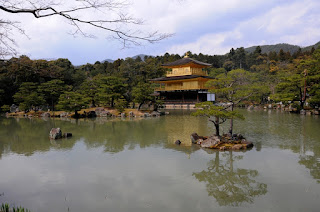
like for one day” passes, mainly because the Golden Temple of Kinkaku-ji is
nowhere near a metro station. Just as well, really, for the weather turned cold
and wet, and buses were all packed. It really was a case of grabbing the first
one and riding it until it ceased to go in a useful direction. The bus passes made
getting off without fumbling for change so much more convenient, and cheaper to
boot.
![]() |
Golden Temple of Kinkaku-ji |
When it finally became necessary
to head for the airport, it occurred to Beloved Wife that the JR passes could
buy tickets for the Narita Express, and having got to Narita, it was even
possible to obtain a refund for the unused return N-EX tickets. Only at this
point was it revealed that the cards handed over a week previously were
pre-credited smart cards that could have been used all over the Tokyo metro
system, instead of rummaging for change. D’oh! But Japan Rail was quite happy
to refund the unused metro rail credit, much to the Goat’s astonishment.
As for the return flight, it took
off to schedule. Additional passengers boarded at Osaka so the aircraft was
packed back to Doha. And guess what. The flight was delayed in the air for half
an hour, so there was a huge mad rush to go through transit security in order
to catch the flight to Dubai. Unlike on the outbound leg, this time Beloved Wife and Goat were obliged to remove all their metalwork and be X-rayed. It would be unthinkable to allow anything illicit from a Qatar Airways flight into the transit lounge of Doha International Airport.
Fair enough that Qatar Airways held
flights for incoming connecting passengers and their checked bags, but it’s not
a patch on the precision ballet of rail timing that seems to occur all over
Japan, tai-fun excepted.
This blog post has dealt mainly with Japan's generally impressive public transportation systems. More will follow
once the Goat has further meshed his detritus.
Tuesday, March 27, 2012
Tyred of this
Large and virile motorcycles destroy tyres. Getting 10,000km
out of the rear rubber can be quite an achievement, and the weight of the
Goatcycle causes the front one to wear out at an alarming rate too. The local
Pirelli agent carries a tiny selection of very expensive bike tyres. Part of
the reason for the expense is that they’re actually street-legal racing rubber:
exceptionally grippy and incredibly soft. I don’t want racing tyres on a
sports-tourer. Being the Stig’s slow, fat cousin, I’ve little need for
excessive grip. I only want enough so that the bike won’t go slideways on
roundabouts. Tyres that don’t immediately wear down to the cords after riding
in a straight line would be good too; Qatar doesn’t have very many bendy roads.
The perfect solution is a multiple-compound tyre, which is rock hard in the
middle and soft and sticky at the edges.
The local Continental Tyres dealer carries such tyres, but
not in my sizes, and no he doesn’t know when he’s going to get some Road
Attacks. “Maybe April. Insha’Allah.”
Kawasaki does have some original equipment Bridgestones, but
I don’t want those. I know from experience that they are less than
confidence-inspiring, and are the only tyres I’ve ever encountered where the
front wears out faster than the rear. It must take some extra special design
expertise to achieve this, at the same time delivering soft rubber that doesn’t
grip very well. Either Pirelli or Metzeler suit me and the bike very well, but
suitable sizes are Not Coming In Doha™.
The Michelin agent promised that he’d call me. Much as
anticipated, he hasn’t, so the apparently wonderful dual-compound Pilot Road 2s aren’t going
to happen to a bike near me any time soon.
So it seems as if I’m unable to give my free money to the
local agents, and instead eBay and Aramex Shop-n-Schlepp will get the business.
Now probably in the autumn because I’ll not do much riding over the summer
months, and the current tyres still have some realistic life.
It’s not just motorcycle tyres. I’m trying and failing to
locate replacement rubber for Rio, the Tear-Arse. I’d like something slightly
more knobbly than the stock tyres, and maybe just a teeny bit bigger.
Naturally, nobody has my size in stock, especially the alleged purveyor of my
favourites, Cooper Discoverer ATRs. “Maybe April. Insha’Allah.”
Actually, I did find one. I need five. Unfortunately the
teeny bit oversize would prevent me from using the hard spare-wheel cover,
which is a bit disappointing. And I’m not paying QAR3,900 after discount (which
is £650 in old money). The Goatmobile cost no more than QAR2,500 to re-boot,
and those were much, much bigger. After the man in the tyre shop removed the
QAR850 sticky label and discovered a QAR625 label underneath, he still wouldn’t
go below QAR2,900.
Part of the tyre supply problem is that a newish law in
Qatar forbids anyone from selling tyres that are more than a specified age,
which may be three years. After that, new stock has to be destroyed. Surprise,
surprise: dealers minimise their stock levels and only carry the fast-moving
lines. There’s also a rule that all after-market tyres must be rated
Temperature A. This is sensible, given the ludicrously high temperatures the
region attains during the summer. Yet vehicles are imported and sold as
merchantable with Temperature B tyres fitted. Might it not be a good idea to
legislate for the higher rating to be supplied to consumers when they buy new
cars? And while we’re obsessing with rules to protect us from dodgy tyres, how
about doing something about the appalling state of truck tyres on most HGVs?
The legal minimum tread depth is not “It’s OK if it stays inflated.”
Why am I looking to replace car tyres already? Well, my new
Daihatsu has been standing in the showroom since 2009 and the tyres have all
developed flat spots. This was very obvious when I had the wheels balanced.
I’ve argued the toss with the Daihatsu workshop, citing words like
“merchantable quality” and “warranty”, but the manager sent me away and
suggested that the flat spots would go away by 5,000km. I suspect the only true
bit is the sending away. There is precisely zero evidence so far that the flat
spots are disappearing.
]}:-{>
Sunday, March 18, 2012
Mid-life crisis
I’ve
managed to avoid the desire for a two-seater open-top sports car. The bike
doesn’t count because I’ve owned large motorcycles since I was a teenager.
]}:-{>
The
other thing I’ve been doing since my teenage years is engineering. First,
science O and A levels, then a civil engineering degree. After graduating with
a Desmond (Gaudeamus igitur), I spent six months as a motorcycle courier
before finding a proper job in the civil engineering profession. And I’ve been
more-or-less continually employed ever since. Twenty-six years: you don’t get
that for murder.
Regrettably,
this is now how I feel about it. Instead of actual engineering, which a
colleague described as “an industry which needs a couple of big buckets of
common sense,” I find myself being inexorably tractor-beamed into the Death
Star of Financial Management and Quality Assurance. There seem to be
ever-increasing layers and layers of Business Bollocks between me and actually
Getting Things Done.
I’m
driven to wonder how anything ever got built before the post-war introduction
of Gantt charts and Quality Plans; before Construction Design Management. Are
all those Victorian and older structures merely figments of my diseased imagination? Was the universe
created yesterday, complete with false memories? The oldest bridge in the world
is the Pons Fabricius in Rome, which was built in 62BC. How did the Romans
build that?
“They
had massive whips, Rimmer. Massive, massive whips.”
The engineering industry has openings for Planning Engineers and Quality Assurance Specialists. If I wanted an electrical sub-station designing, I’d get an electrical engineer. Why then am I expected to be a master of all trades where planning and QA are concerned?
My
point is that I’ve become completely disillusioned with everything I do for a
living. It pays well, but I only continue to do it so that one day I’ll have
enough saved up so that I don’t have to do it any more. Ten more years. A
decade. Not so much a word as a sentence.
So
I need a change. Changing employer would only exchange frying pan for fire. And
because of employment laws in Qatar I’d need a No Objection Certificate from my
current employer or be banned from working in Qatar for two years. NOCs are Not
Coming In Doha, Mr Goat.
What
else could I do, assuming a career rather than merely a country change? Having
done engineering for so long, I have a very narrow set of skills. What I do, I
do very well. And I must be good at it; feelings of self-doubt are logically
unfounded because if I were a fraud I’d surely have been found out in under 26 years.
· Barring
the vanishingly unlikely chance of making it big on Britain’s Got [not very
much] Talent, any alleged ability I may have as an actor or singer isn’t
enough to make a living.
· Writing
bestsellers? Read Alexander’s blog about self-publishing and marketing his
book. All I need is an original idea, a plot, and some protagonists. “The
first in the Phuqinora trilogy from a major new talent.” Yeah, right. I can
just see that happening.
· Driving,
perhaps? I can do that, and I even earned some money once for piloting a car in
a TV advert. It’s a small and irregular income stream. I don’t need to do
motorcycle courier work again, and I don’t have nearly enough tattoos to
qualify as a proper White Van Man.
· Scuba
instructing sounds like a great idea, and it’s something I can actually do.
Getting paid to dive every day in the tropics? Getting paid a pittance, more
like, until my abused middle-aged body gave up in disgust.
· Retraining
as a teacher? Frankly, notwithstanding any ability I may have as a teacher, the
mere concept of standing in front of a class in order to put food on the table
fills me with abject horror. Full marks for anyone who does it!
So
I’m stuffed. I can’t stand doing what I’m doing for much longer; certainly not
for ten more years, and I can’t not do it for fear of never being able to
afford to retire.
]}:-{>
Subscribe to:
Posts (Atom)


